
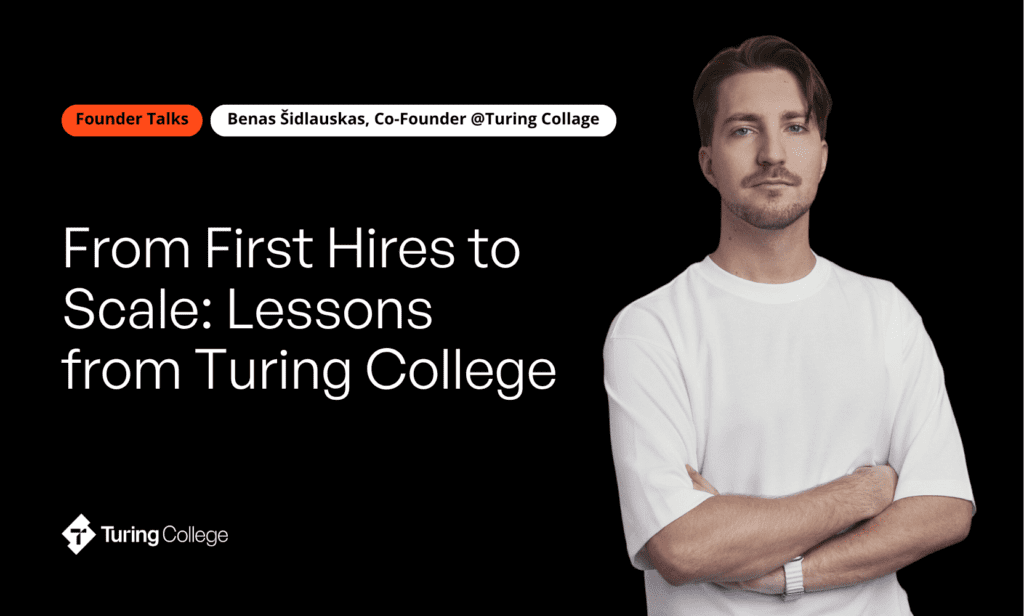
From 3 founders to 60+ people, hiring “all-in” talent and building a culture that holds under pressure
Building a startup team sounds simple on paper. You hire smart people, align on a vision, and execute. In reality, it rarely works that way.
In this conversation, FIRSTPICK sat down with Benas Šidlaukas, co-founder and CBDO of Turing College, to unpack what really happens behind the scenes, from trying to be taken seriously as 20-something founders in EdTech to building a 60+ person international team. The journey was far from clean, which is exactly what makes it worth paying attention to.
The Early Days
FIRSTPICK: Let’s go back to the beginning. Three founders, early days. Did you already know each other?
Benas Šidlauskas: Yeah, it goes way back. Lukas Kaminskis and I were best friends from high school. We met through debating competitions. At first, we were competitors, trying to prove who was better, and that turned into a friendship.
Later, we met Tomas Moška. He was actually the first Lithuanian to get into 42 University, which is quite a unique model, no lectures, no teachers.
At that time, we were already doing small things together, organising tech events and bootcamps. That’s where the idea started forming.
Trying to Build Something Without Credibility
FIRSTPICK: You were very young at the time. How did people take you seriously?
Benas: It was a hard start. We were 22 or 23. No PhDs, no master’s degrees, and we were trying to change education. That’s not exactly a space where people take you seriously.
At the beginning, it was more like a student initiative called Turing Society.
We wanted to create high-quality education, similar to what we saw in Harvard CS50 or 42 University. But those programs were expensive, around $15,000.
So we built something similar and sold it for 50 or 100 euros.
The biggest problem wasn’t the product. It was credibility.
Also, a small note from our side, some members of the FIRSTPICK team were among the early investors in Turing College. Watching what you’ve built since those early days makes us genuinely proud.
From Facebook Message to Harvard Partnership
FIRSTPICK: I heard you tried to partner with Harvard quite early?
Benas: Yeah, we were quite naive. We just wrote them an email. Of course, no one replied.
Then we tried something else. We found the Lithuanian Minister of Education on Facebook and messaged her.
She replied.
We met her the next week, got an official letter from the Ministry, and after that Harvard responded and invited us to Boston.
That’s how we got the partnership to teach CS50 in Lithuania.
That was one of the first moments where we felt like, okay, now we’re taken seriously.
The First Hires: The Moment It Became Real
FIRSTPICK: Do you remember your first hires?
Benas: One of our first hires was a designer. He’s still with us today. That tells you something.
The second was our Head of People, also still with us.
At the beginning, no one was paid. Not even us. We actually started as an NGO because we couldn’t afford to set up a proper company.
The first real shift happened when we could finally pay salaries. That’s when things got serious.
There’s always a moment where someone on the team says, “I either need to get paid now, or I have to leave.” That was the tipping point.
The “All-In” Hiring Rule
FIRSTPICK: You’re now around 60 people. Are founders still involved in hiring?
Benas: Yes, definitely. We trust our team, but one of the founders still has the final say. We took inspiration from companies like Airbnb and Stripe.
For us, the key question is whether the person is “all-in.”If you hire someone who is 100%, they will push others to also be 100%. If someone is 80%, the people below might become 50%. And then you start feeling it across the company.
The Signal They Trust More Than Experienc
FIRSTPICK: What do you look for in candidates?
Benas: One simple thing, whether the person has been doing something for a long time.
It doesn’t have to be work. It can be music, sports, anything.
If someone sticks with something long enough, it shows they have the drive to improve.
For example, I started DJing as a hobby and ended up playing at festivals. That consistency matters more than just saying you’re motivated.
Culture: Direct, Sometimes Uncomfortable
FIRSTPICK: How would you describe your company culture?
Benas: We’re very direct.
If something is wrong, we say it directly. We even have a hashtag, #ShitHitTheFan. Not everyone likes that, but it works. We don’t try to go around problems.
At the same time, we try not to become just managers. Even as founders, we’re still learning, taking courses, keeping up with what’s happening. I think the team respects that we’re not detached.
The System That Keeps 60 People in Sync
FIRSTPICK: How do you keep everyone aligned?
Benas: We have a weekly team meeting every Monday, 30 minutes.
We start with one question to get everyone involved, something simple like what motivated you last week.
Then company highlights, and then we highlight a “Silent Hero,” someone who did something important that others might not have noticed.
We also have anonymous questions, so people can ask anything, about runway, strategy, anything.
Before the meeting, every team shares their key updates and priorities for the next week.
We started this when we were around 20 people. I’d actually recommend starting it earlier.
Hiring A-Players (Even When They’re Not Looking)
FIRSTPICK: How do you approach motivation and attracting strong talent?
Benas: At the beginning, we allocated around 10% of shares for early employees, and later added a few more percent. That matters, but honestly, equity alone doesn’t convince the right people.
What worked for us was building a strong core team early on. Once you have a few really strong people, they start attracting others.
Also, A-players are usually not actively looking for a job. You don’t really “hire” them, you go after them.
And sometimes that means being persistent.
I remember when we were hiring our current COO. I was constantly sharing updates with her, what we’re building, where we’re going. I even wrote to her a day before her wedding and a day after. Not pitching, just showing how things are moving. She joined because she believed in what we were building and saw the momentum behind it.
The same happened recently when we hired a senior sales director from well-known companies in the UK. Again, it came down to persuasion and being real about where we are.
You need to show ambition, but at the same time not sound delusional. If you manage to get A-players early, you give yourself room later. If you start with weaker hires, it’s much harder to fix that.
Making Remote Teams Feel Included
FIRSTPICK: Your team is now international. How do you keep culture strong?
Benas: We noticed that people in Lithuania felt more connected than remote team members.
So we introduced things like “Coffee Buddy,” where you randomly talk to someone for 30 minutes, not about work.
We also have a “Gratitude Wall” where people can publicly thank each other.
It’s simple, but it helps people feel included.
The Part No One Tells You
FIRSTPICK: After five years, does it feel more stable?
Benas: Not really. Even today, before this meeting, I had two completely different emotions. In the morning, everything felt amazing. In the afternoon, it felt like everything was falling apart. And then it went back to normal again. That doesn’t go away.
FIRSTPICK: What stands out in this conversation is the clarity and openness behind every decision.
Building a strong team takes consistency, intentional hiring, and the ability to stay focused on what truly matters as you grow. The way Turing College approaches people, culture, and communication shows how these elements come together over time.
Benas, thank you for sharing your experience so openly and for the practical insights you’ve given throughout this conversation. We believe this interview will bring real value, especially for first-time founders, as well as for anyone building and growing a team.
Your journey reflects what consistency and persuasion can achieve when applied over time. It’s inspiring to see how Turing College continues to grow and shape the EdTech space.
Some members of the FIRSTPICK team were among the early investors in Turing College. Watching what you’ve built since those early days makes us genuinely proud. Keep going. 🔜🦄💜
Turing College is an online AI college for busy professionals. We train machine learning & data science, analytics, data engineering in 6-24 months and help to get a job or a raise afterward. At Turing College, you learn from industry professionals that finished their PhDs at Oxford, and Cambridge universities and worked at META, Amazon, and IBM. Turing College trains talent to match industry needs and provides companies with instant access to exceptional talent that has yet to enter the market.